Monday, May 20, 2013

Figurative Language & Symbols in Poetry

  1. Review some major forms of figurative language by completing 20 examples on the worksheet: http://www.ereadingworksheets.com/figurative-language-worksheets/Identifying_Figurative_Language_3.pdf
  2. Colors can give your poems some symbolic significance through the different connotations that we associate with colors.  Examine the following chart that outlines some color symbolism.  Read some poems that make use of color symbolism.  Respond to two of the poems.  Identify the title and author and describe briefly what effect the poet’s use of color had on the poem.
  3. Write at least ten lines of poetry (this can be one or more poems, but there must be at least ten lines of poetry total) that use at least two colors to convey symbolic meaning and tone.  Please note, you can also play with different words for the same color (for example: red, scarlet, vermilion, crimson, rusty, cherry, burgundy and ruby may all carry different connotations).  Your ten lines of poetry should also incorporate at least two examples of figurative language (similes, metaphors, personification, and/or hyperboles.)  


Color Symbolism Chart
Excitement, energy, passion, love, desire, speed, strength, power, heat, aggression, danger, fire, blood, war, violence, all things intense and passionate.
Pink symbolizes love and romance, caring, tenderness, acceptance and calm.
Beige and ivory symbolize unification. Ivory symbolizes quiet and pleasantness. Beige symbolizes calm and simplicity.
Joy, happiness, betrayal, optimism, idealism, imagination, hope, sunshine, summer, gold, philosophy, dishonesty, cowardice, jealousy, covetousness, deceit, illness, hazard and friendship.
Peace, tranquility, cold, calm, stability, harmony, unity, trust, truth, confidence, conservatism, security, cleanliness, order, loyalty, sky, water, technology, depression, appetite suppressant.
Turquoise symbolizes calm. Teal symbolizes sophistication. Aquamarine symbolizes water. Lighter turquoise has a feminine appeal.
Royalty, nobility, spirituality, ceremony, mysterious, transformation, wisdom, enlightenment, cruelty, arrogance, mourning.
Lavender symbolizes femininity, grace and elegance.
Energy, balance, enthusiasm, warmth, vibrant, expansive, flamboyant, demanding of attention.
Nature, environment, healthy, good luck, renewal, youth, spring, generosity, fertility, jealousy, inexperience, envy, misfortune, vigor.
Earth, stability, hearth, home, outdoors, reliability, comfort, endurance, simplicity, and comfort.
Security, reliability, intelligence, staid, modesty, dignity, maturity, solid, conservative, practical, old age, sadness, boring. Silver symbolizes calm.
Reverence, purity, birth, simplicity, cleanliness, peace, humility, precision, innocence, youth, winter, snow, good, sterility, marriage (Western cultures), death (Eastern cultures), cold, clinical.
Power, sexuality, sophistication, formality, elegance, wealth, mystery, fear, evil, unhappiness, depth, style, evil, sadness, remorse, anger, anonymity, underground, good technical color, mourning, death (Western cultures).

Tuesday, May 14, 2013

Branches of Government

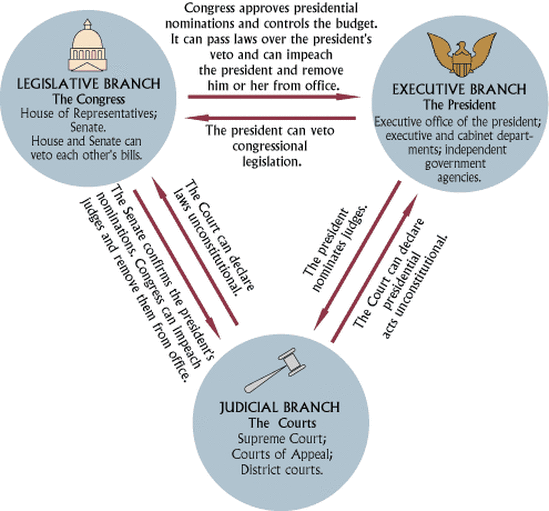
Now that you've studied all three of the branches of U.S. Government (legislative, executive, & judicial), you can play the Branches of Power game from iCivics.org.  Remember to print out your certificate for credit!

Monday, May 13, 2013

Judicial Branch Games


  1. After you have finished reading and completing notes about 8.3: The Supreme Court, you are ready to play Court Quest which tests your knowledge about the different types of courts in the United States.  Good luck navigating the judicial branch!
  2. After reading and completing 8.4: The Supreme Court at work, you are ready to play Argument Wars in which you argue a real Supreme Court Case!

**Remember to print out your certificates.  You must win your case in Argument Wars AND get a good score (at least 70%) in Court Quest to get full credit.

*For 2 bonus points, you may also play Supreme Decision OR Executive Command.


Discrimination

Watch PBS's Frontline's "A Class Divided": http://www.pbs.org/wgbh/pages/frontline/shows/divided/etc/view.html

Friday, May 10, 2013

Introduction to Poetry


Task 1:  Complete this worksheet about major poetic devices.  (4 points)

Task 2: Complete the poetry analysis worksheet to learn how poets use some of these devices. (3 points)

Task 3: (1 point)  Alliteration Tongue Twisters:  Write an original alliteration tongue twister that incorporates at least seven alliterations with the same initial sound and (at least somewhat) makes sense.
  • Remember, alliteration is when two or more words share the same initial sound
    • Ex. “Down and Dirty”
  • When you string a bunch of alliteration together, you get a tongue twister.
    • Peter Piper picked a peck of pickled peppers.

Task 4: (2 points)  Write a limerick, a five line poem that follows the rhyme scheme A A B B A, in which the “A” lines are eight or nine syllables and the “B” lines are six syllables.  See three different examples below:  

There once was a gray poodle named Spark.       (A= "ark," 9 syllables long)
 Quite talkative, he so liked to bark.                     (A= "ark," 9 syllables long)
 Sometimes running he found                             (B= "ound," 6 syllables long)  
 His feet all off the ground                                 (B= "ound," 6 syllables long)
 Especially on "walks" in the park.                      (A= "ark," 9 syllables long)

There once was a girl who loved rhyme;   (8 syllables)
 She felt her writing was sublime.             (8 syllables) 
 Indeed quite a poet,                                 (6 syllables)
 Though some didn't know it,                    (6 syllables)
 She'd be rich if each paid a dime.              (8 syllables)

There was a mean clown in the circus.
 For fun he would push us and jerk us.
 He would hit us with pies
 That left cream in our eyes.
 His act never once failed to irk us.


Thursday, May 9, 2013

Gender Inequality & Language


Use the National Council of Teachers of English (NCTE)’s “Guidelines for Gender-Fair Use of Language” at http://www.ncte.org/positions/statements/genderfairuseoflang to review how to avoid perpetuating stereotypes, assumptions, and inequalities in your writing.

Tuesday, May 7, 2013

Creative Writing: Revising, Editing, & More Root Words

  1. Revise your story according to the notes your teacher gave you.  Make sure to type it up (double-spaced).
  2. Edit your story with your teacher.
  3. Complete the activity More Root Words.