
Showing posts with label Psychology/Sociology. Show all posts
Showing posts with label Psychology/Sociology. Show all posts
Monday, May 4, 2015
Gender-Fair Language
Go to the National Council of Teachers of English (NCTE)'s "Guidelines for Gender-Fair Language" website to complete the form. Follow your teacher's directions, too.

Wednesday, March 11, 2015
Culture Videos
When you have finished writing your essay and have conferenced and revised/edited it with Kapp, watch the following videos to review key culture terms:

- Ethnocentrism and Cultural Relativism
- What is normal? Exploring folkways, mores, and taboos
- What is material culture?
- Culture Lag & Culture Shock
- Everything you always wanted to know about culture
Wednesday, February 4, 2015
Socialization
These videos are intended to accompany your notes for What is Human Nature?
1. 10 Disturbing Cases of Feral Children.2. TLC's "Wild Child" about Isolated Child: Genie Wiley.
3. Institutionalized Children: Romanian Orphans.
4. Deprived Animals: Watch a video of Harlow's monkeys.
5. IF time allows, review the Three Theoretical Perspectives of Sociology.

Friday, January 9, 2015
Psychology Midterm Essays
Essay/Extended
Response
In complete paragraphs, answer THREE of the following questions for 10 points each.
1.
Discuss the ethics of psychology. How do
psychologists know that they are acting ethically? Why is important that
psychologists reflect on the ethics of their practices? What are some examples
of unethical practices/experiments and what were the consequences? Why have
some psychologists acted unethically?
2.
Discuss the controversy of psychological
medication, especially when it comes to children. Refer to the documentary “The Medicated
Child” from PBS’s Frontline and discuss both sides of the issue as well as your final opinion.
3.
Discuss the different specialties within the
career field of psychology. Why are there so many different types of
psychologists? Which fields interest you most and why? Which field(s) are least
interesting to you and why? Even though they may not interest you personally,
why do these other specialties exist?
4.
Discuss one’s moral development. Make specific references to Kohlberg’s theory
of moral development. You may discuss
this theory in terms of your own life and/or other situations in the news/media/history/literature. Discuss the stages and if you agree with
Kohlberg’s classification.
5.
Discuss intelligence. What does it mean to be
intelligent? What does it mean to lack intelligence? Discuss some key terms
surrounding intelligence and discuss various theories and controversies that
surround intelligence as well as your own ideas as they relate to psychological
thought about intelligence.
6.
Discuss the theory of multiple intelligences.
Explain the theory and how you tested. Explain how this knowledge may help you.
Finally describe how seriously you take this information.
7.
Compare and contrast two theories of
personality. Describe your own personality in terms of each of these theories
and tell which theory you like better, explaining why.
8.
Discuss one mental illness that interests you
in depth. Discuss why you are interested in this disorder as well as its
potential causes and effects. Discuss treatment options and their upsides and
downsides. What should patients with this disorder do? What should friends and
families of people with this disorder do? What should society do? WHY???
RUBRIC
·
10 points =
Student clearly answers all parts of the prompt, providing multiple
specific and relevant examples from his/her studies and/or observations. Writing has a clear introduction (thesis in
which an original argument is asserted), body, and conclusion.
·
9 points =
Student clearly attempts to answer all parts of the prompt, providing
some specific and relevant evidence from his/her studies and/or
observations. Writing has a clear
introduction (thesis), body, and conclusion.
·
8 points =
Student answers most parts of the prompt, providing relevant evidence
from his/her studies and/or observations.
Writing has a clear introduction, body, and conclusion.
·
7 points =
Student attempts to answer the main part of the prompt, providing
somewhat relevant evidence from his/her studies and/or observations. Writing has a clear introduction and body.
·
1-6 points =
Student’s answer lacks clarity and/or organization discussed above.
Monday, January 5, 2015
Thursday, December 11, 2014
Somatoform, Factitious, Dissociative, & Schizophrenic Disorders
Before reading, watch:
1. Schizophrenia
After:
1. Dissociative Identity Disorder (9 min)
2. Somatoform Disorders (6 min)
3. Factitious Disorders (3 min)
4. Schizophrenia (5 min)
1. Schizophrenia
After:
1. Dissociative Identity Disorder (9 min)
2. Somatoform Disorders (6 min)
3. Factitious Disorders (3 min)
4. Schizophrenia (5 min)
Thursday, September 25, 2014

Wednesday, September 3, 2014
Five Approaches to Psychology
You have learned about the five major approaches to psychology--behavioral, biological, cognitive, humanistic, and psychoanalytic.
To review, watch the video and take the quiz from the lesson taught by Polly Peterson!

To review, watch the video and take the quiz from the lesson taught by Polly Peterson!

Thursday, March 6, 2014
Hip-Hop Culture:
View the documentary: "Hip-Hop: A Culture of Peace."
Take notes on the material and nonmaterial aspects of the culture.
Then, write a response that discusses the following:

Take notes on the material and nonmaterial aspects of the culture.
Then, write a response that discusses the following:
- What makes “Hip-hop” a unique culture? Use at least seven (7) of the following terms:
- material culture
- nonmaterial culture
- symbolic culture
- values
- norm
- sanction
- folkway
- more
- taboo
- Is “hip-hop” a subculture
or a counterculture? How do you know?
- Would you experience
culture shock in this culture? Explain.

Tuesday, February 4, 2014
Socialization
First, if time allows, review the Three Theoretical Perspectives of Sociology.
These videos are intended to accompany your notes for What is Human Nature?
1. National Geographic's Feral Children series: Part 1, Part 2, Part 3, Part 4, and Part 5.
2. Nova's "Wild Child" about Isolated Child: Genie Wiley. continue at 20:20
3. Institutionalized Children: Romanian Orphans.
4. Deprived Animals: Watch a video of Harlow's monkeys.
Wednesday, January 15, 2014
Psychology Midterm Essays
Essay/Extended
Response
In complete paragraphs, answer THREE of the following questions for 10 points each.
1.
Discuss the ethics of psychology. How do
psychologists know that they are acting ethically? Why is important that
psychologists reflect on the ethics of their practices? What are some examples
of unethical practices/experiments and what were the consequences? Why have
some psychologists acted unethically?
2.
Discuss the controversy of psychological
medication, especially when it comes to children. Refer to the documentary “The Medicated
Child” from PBS’s Frontline and discuss both sides of the issue as well as your final opinion.
3.
Discuss the different specialties within the
career field of psychology. Why are there so many different types of
psychologists? Which fields interest you most and why? Which field(s) are least
interesting to you and why? Even though they may not interest you personally,
why do these other specialties exist?
4.
Discuss one’s moral development. Make specific references to Kohlberg’s theory
of moral development. You may discuss
this theory in terms of your own life and/or other situations in the
news/media/history/literature. Discuss
the stages and if you agree with Kohlberg’s classification.
5.
Discuss intelligence. What does it mean to be
intelligent? What does it mean to lack intelligence? Discuss some key terms
surrounding intelligence and discuss various theories and controversies that
surround intelligence as well as your own ideas as they relate to psychological
thought about intelligence.
6.
Discuss the psychology of teenage development.
Specifically refer to information gleaned from “Inside the Teenage Brain”
(PBS’s Frontline) as well as your own experiences. Why is this such a
unique and important time, psychologically, in a person’s life?
7.
Discuss one mental illness that interests you
in depth. Discuss why you are interested in this disorder as well as its
potential causes and effects. Discuss treatment options and their upsides and
downsides. What should patients with this disorder do? What should friends and
families of people with this disorder do? What should society do? WHY???
RUBRIC
·
10 points =
Student clearly answers all parts of the prompt, providing multiple
specific and relevant examples from his/her studies and/or observations. Writing has a clear introduction (thesis in
which an original argument is asserted), body, and conclusion.
·
9 points =
Student clearly attempts to answer all parts of the prompt, providing
some specific and relevant evidence from his/her studies and/or
observations. Writing has a clear
introduction (thesis), body, and conclusion.
·
8 points =
Student answers most parts of the prompt, providing relevant evidence
from his/her studies and/or observations.
Writing has a clear introduction, body, and conclusion.
·
7 points =
Student attempts to answer the main part of the prompt, providing
somewhat relevant evidence from his/her studies and/or observations. Writing has a clear introduction and body.
·
1-6 points =
Student’s answer lacks clarity and/or organization discussed above.
Friday, January 10, 2014
The Medicated Child
Watch and take notes on PBS's Frontline documentary "The Medicated Child." There are six parts to the film, when you finish part 1, click on part 2, until you finish the film.
For your final exam, one of your essay options is to discuss the controversy surrounding psychological medication, especially when it comes to children. You'll have to discuss the pros and cons as well as provide an overall opinion supported by facts. It is in your best interest to take notes that will help with this task.

For your final exam, one of your essay options is to discuss the controversy surrounding psychological medication, especially when it comes to children. You'll have to discuss the pros and cons as well as provide an overall opinion supported by facts. It is in your best interest to take notes that will help with this task.
Tuesday, December 3, 2013
Multiple Intelligences
Remember: In 1983 Harvard psychologist Howard Gardner published his theory of multiple intelligences in his book Frames of Mind. Gardner identified eight separate intelligences. He defines intelligences as independent mental abilities characterized by core operations. For example, musical intelligence focuses on the core operations of recognizing pitch and rhythm. Gardner states that most people have at least seven of these intelligences, but that in some people one intelligence may dominate, and in other people the intelligences blend. Below are descriptions of Gardner’s eight intelligences.
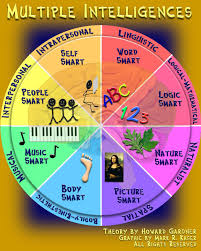
- Linguistic intelligence: the ability to use language to express one's thoughts and to understand other people orally or in writing
- Musical intelligence: the ability to hear music in one's head, and to hear tones, rhythms, and larger musical patterns
- Logical-mathematical intelligence: the ability to manipulate numbers, quantities, and operations accompanied by a love of dealing with abstraction
- Spatial intelligence: the ability to represent the spatial world visually in one's mind
- Bodily kinesthetic intelligence: the ability to use the whole body or parts of the body to solve a problem, create a product, or put on some kind of production.
- Intrapersonal intelligence: the ability to know and understand one's self, including goals, tendencies, talents, limitations
- Interpersonal intelligence: the ability to notice and make distinctions among other individuals; a strong understanding of other people
- Naturalist intelligence: the ability to discriminate among living things and to see patterns; also, a sensitivity to features of the natural world
Your Task
GO TO: Literacy Work's Multiple Intelligences Assessment, take the survey, print out the results, and answer the following reflection questions:
- According to your results, what were your top three intelligences? (If you don’t know what some of these terms mean, please look them up on dictionary.com)
- Do you agree with this analysis? Explain.
- Do any of the other intelligences sound more like you? If so, click on them to learn about them.
- How do you think you learn best?
- How can you use this information to help you?
Tuesday, November 19, 2013
Inside the Teenage Brain
Watch the video. Take 10 notes and write 3 questions as you watch. When the class period is ending, record where you are in the video to finish tomorrow.


Monday, November 4, 2013
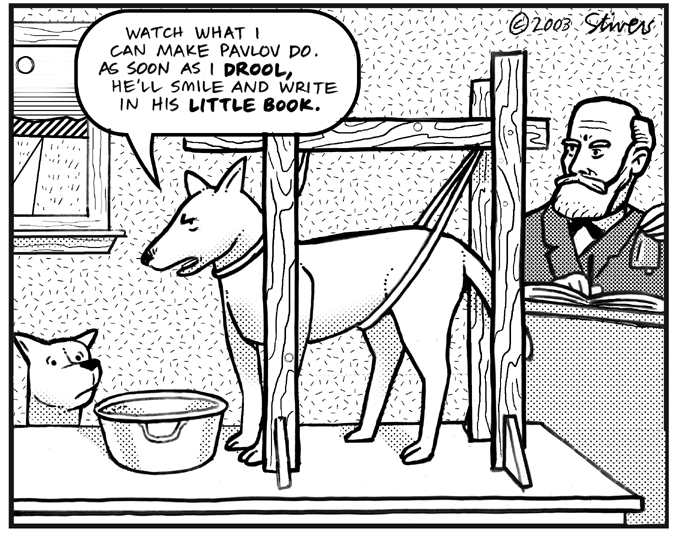
Learning & Conditioning Quiz Information
Know and use these terms:

- unconditioned
- conditioned
- stimulus
- neutral stimulus
- response
- classical conditioning
- operant conditioning
- positive reinforcement
- negative reinforcement
- punishment
- omission training
- latent learning
- observational learning
- PQ4R
Thursday, October 24, 2013
Psychology of Drugs
Write a question that has to do with the psychology of drugs that you really want to answer.
Find an answer from a reliable source.
Email the following to ms.kappelman@gmail.com:
Find an answer from a reliable source.
Email the following to ms.kappelman@gmail.com:
- question (this can be your subject)
- answer to the question (in your own words)
- a link to the source that you got the answer
- brief explanation of why you think that was a reliable source
*You will not have to share these.

Friday, October 18, 2013
Dream & Sleep Questions
Choose one of the starred questions to answer. Find an answer from a reliable source.
Email the following to ms.kappelman@gmail.com:

Email the following to ms.kappelman@gmail.com:
- question (this can be your subject)
- answer to the question (in your own words)
- a link to the source that you got the answer
- brief explanation of why you think that was a reliable source

Tuesday, September 10, 2013
Five Approaches to Psychology
You have learned about the five major approaches to psychology--behavioral, biological, cognitive, humanistic, and psychoanalytic.
To review, watch the video and take the quiz from the lesson taught by Polly Peterson!
To review, watch the video and take the quiz from the lesson taught by Polly Peterson!
Wednesday, June 5, 2013
Exploring Religious America
Refer to the video below to accompany your worksheet:
PBS. 26 April 2002. “Exploring Religious America, Part One.” Religion & Ethics
Newsweekly. Educational Broadcasting Corporation. 2013.

Monday, June 3, 2013
Sociology Final Exam Essay Choices
Directions:
In
complete paragraphs, answer THREE (3)
of the following questions for 10 points
each.
A.
Describe the Bystander Effect and write a
situation in which you explain the variables about why one would or would not
help a stranger.
B.
Compare and contrast the three major theories of sociology. How does each respond to a
sociological question?
C.
Discuss your own socialization, specifically how
three or more agents of socialization
have made you who you are.
D.
What is a total institution? Describe its purpose and how it achieves this
purpose, using at least two real
world examples.
E.
Why does deviance occur? How should society handle deviance? Think of
our studies and your own observations/experiences?
F.
Discuss one of the documentaries that we watched
this semester from a sociological standpoint.
Argue for its educational value and use in the classroom using sociological terms that you learned
from class. Choose one below:
a. National
Geographic’s Feral Children series
b. PBS’s
NOVA’s “Wild Child”
c.
Trekkies
d. Decoding the Past’s “Cults: Dangerous
Devotion”
e. National
Geographic’s “Sex, Lies, & Gender”
f. PBS’s
Frontline’s “A Class Divided”
G.
Why and how does inequality occur? What effects
does it have? What can be done to eradicate inequality? Offer various
sociological responses as well as your own opinion, providing examples of each.
You may focus on inequality in general or explain it in relation to one group
in society (women, African-Americans, Muslims, etc.)
RUBRIC
·
10 points =
Student clearly answers all parts of the prompt, providing multiple
specific and relevant examples from his/her studies and/or observations. Writing has a clear introduction (thesis in
which an original argument is asserted), body, and conclusion.
·
9 points =
Student clearly attempts to answer all parts of the prompt, providing
some specific and relevant evidence from his/her studies and/or
observations. Writing has a clear
introduction (thesis), body, and conclusion.
·
8 points =
Student answers most parts of the prompt, providing relevant evidence
from his/her studies and/or observations.
Writing has a clear introduction, body, and conclusion.
·
7 points =
Student attempts to answer the main part of the prompt, providing
somewhat relevant evidence from his/her studies and/or observations. Writing has a clear introduction and body.
·
1-6 points =
Student’s answer lacks clarity and/or organization discussed above.
Subscribe to:
Posts (Atom)